For care operators and educators outside Japan
Bring this way of caring
to your own country.
Advice and training from a care provider in rural Kyoto, for people building a care home or a care education programme of their own.
Who this page is for
You are building something.
We would like to hear about it.
Kuromamesan has run elderly care in Japan for more than twenty years, in a small village in the hills of Kyotamba, Kyoto.
This page is for people outside Japan who are building something of their own:
A care home or a day centre, already open or still on paper.
A care course at a university, a college or a training school.
Care services or care training for an organisation.
If that is you, we can help you shape the idea for your country, train the people who will teach it, and share our curriculum.
This is a new part of our work. That is why there is no package on this page and no price list. We would rather start by listening to what you are building, and then tell you honestly whether — and how — we can help.
What you would be taking home
Not our village.
The question behind it.
Our care has a name: Care that awakens the heart — in Japanese, 心を起こす介護.
It began with one woman. She had been bedridden at home, and when she came to us we did everything properly: bathing, toileting, meals, transport. Then she told us she would rather die than be looked after like this.
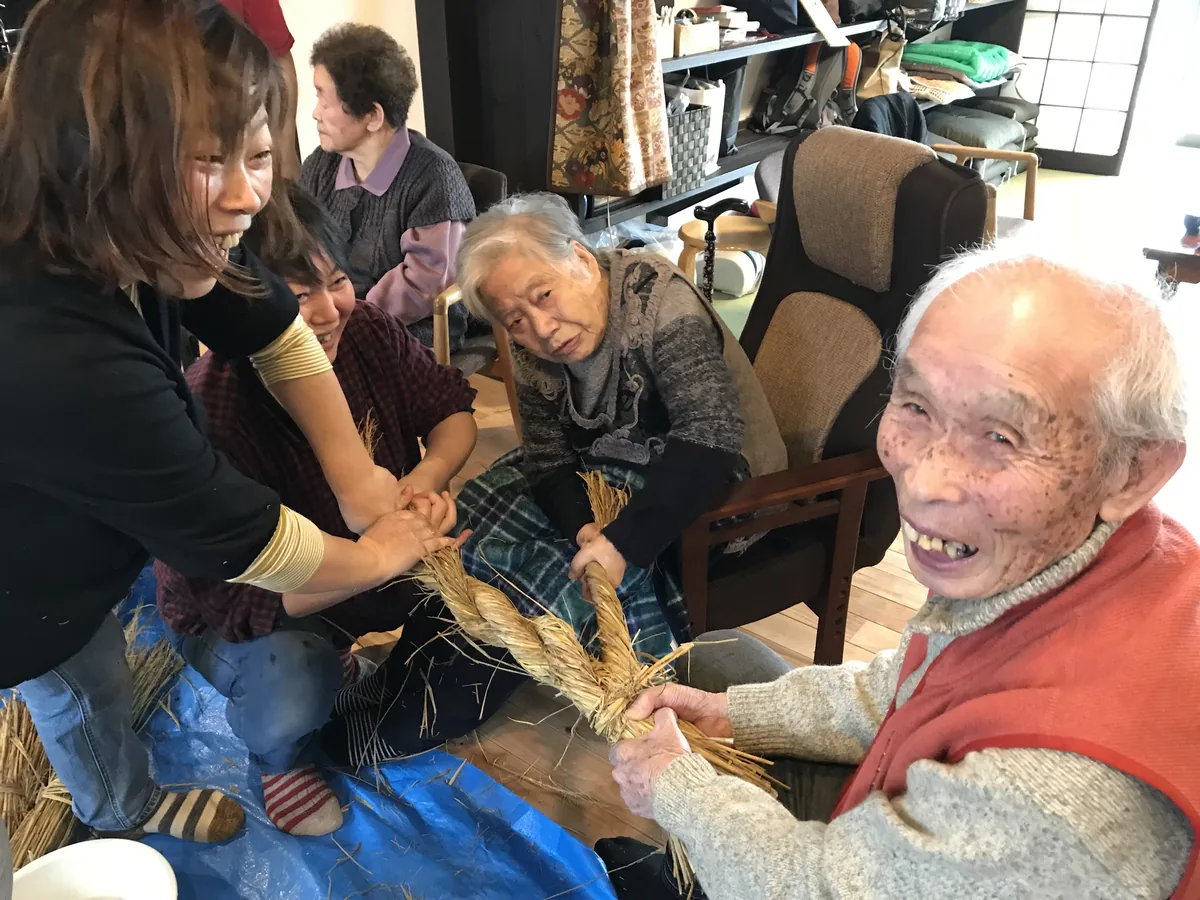
So we stopped, and asked her to teach us instead — how to pickle vegetables, how to plant azuki beans, how to cook rice over a wood fire. Within months she was walking with a frame, and smiling, and helping us.
She had not lost the ability to walk. She had lost anything worth walking toward.
Since then, the older people here are not only people who need help. They teach, they contribute, and they have a role in everyday life. In our village that role comes from country life: the field, the kitchen, the wood-fired stove.
Your country does not have our village. It does not need to.
What travels is not the farmhouse or the wood fire. It is the question we start from: what can this person still teach us? In a city, in another climate, in a classroom, the answer will look different. Working out what it looks like where you are is the work we would do together.
Track record
What we have actually done.
A short list, and every line of it is true.
More than twenty years of elderly care in Japan.
Day-to-day care for older people, in Kyotamba, Kyoto.
A care trainer from China, for fourteen days.
Someone who teaches care for a living, putting into words what makes this place different.
The video loads only when you press play.
A group visit arranged by the ASEAN-Japan Centre.
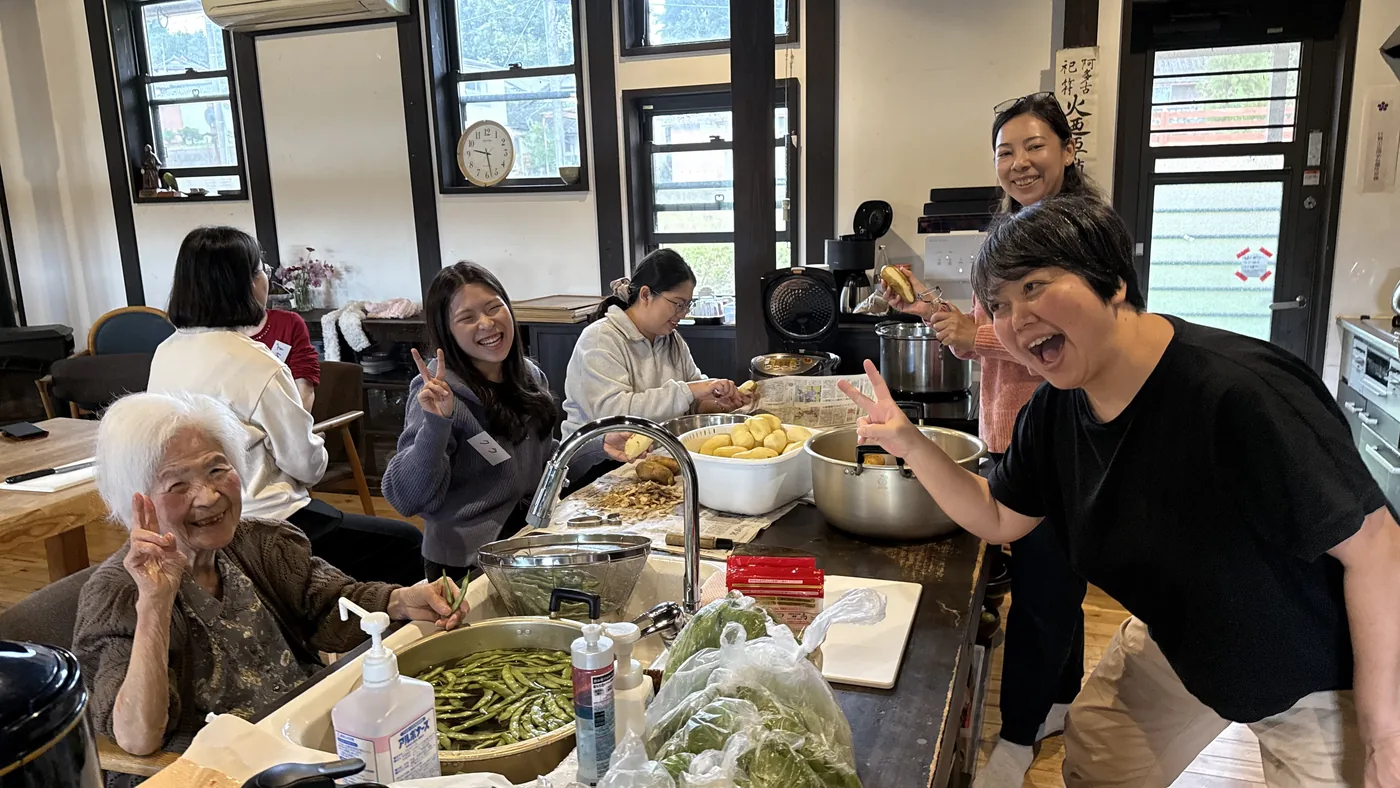
In November 2026 we hosted a two-day visit arranged by the ASEAN-Japan Centre, the intergovernmental organisation established by Japan and the ASEAN member states. Five students came — from Cambodia, China, Indonesia, Laos and Singapore — with two of the Centre’s staff and a supervisor from the ASEAN-Korea Centre, as part of the Centre’s ASEAN+3 Age2Age programme. They took part in the hands-on care programme, got dinner ready alongside the people who live here, and stayed the night in our farmhouse.
The ASEAN-Japan Centre has published its own report on ASEAN+3 Age2Age.
Groups of up to fifteen.
We can host groups of up to fifteen from universities and other institutions, though not on every date.
What we can help with
Five ways we can work with you.
You will not need all five. Tell us which matter to you, and we will start there.
1. Shaping the idea for your country
We help you turn Care that awakens the heart, and the idea of care rooted in country life, into something that fits your culture, your building and the people you serve. What role can older people take in your setting? What takes the place of our field and our wood-fired stove? We work that out with you.
2. Training the people who will teach
We do not try to train your whole staff from here. We train the people who will teach them — the care technique, and the thinking behind it — so that they can pass both on. The technique is the one we teach here every day: helping people roll over, sit up, stand and transfer by using their own movement, in a way that also protects the caregiver’s body.
3. Curriculum and teaching material
Videos of our care technique and a curriculum to teach it from — provided to you, or reviewed alongside the one you already use. A monthly online study session keeps your trainers in touch with us after the training.
4. Running a small place that people find
How a small care home becomes part of its neighbourhood, and how it finds the people it cares for and the staff it needs. This includes what we have learned from sharing our everyday life on social media, which has brought attention from around the world to a care home in a small Japanese village.
5. Licensing (in future)
If you want to use the Kuromamesan name or method formally, we are open to talking about a licence. We have not set up a licensing scheme yet. If this is what you are looking for, tell us — it will help us decide how to shape it.
What we do not do
- Advice on your country’s laws, regulations or care qualifications
- Finding or arranging funding
- Running your facility day to day
You know these far better than we could. Our part is the care itself, and the thinking behind it.
How it works
It starts with a conversation.
- Step 1
Write to us. Use the form below: who you are, what you are building, and where. A few lines is enough to begin.
- Step 2
We talk online. A video call with Kota Inaba of Kuromamesan. You tell us what you are building; we tell you how we work, and whether we think we can help. If we are not the right people, we will say so.
- Step 3
We send you a proposal. If it looks like a fit, we write up what we would do, over what period, and what it would cost. Nothing is decided until you agree to it.
A note on language: we are still learning English, so we use AI translation to close the gap where we need to. So far we have never had any trouble understanding each other.
If you would like to see it before you decide, you or your trainers can come and stay through our care programme in Japan, from 2 to 14 days.
Contact
Tell us what you are building.
We read every message ourselves and reply by email, in English, usually within a few days.
Prefer email?
Write directly to [email protected] and tell us what you are building.